Quantity and availability
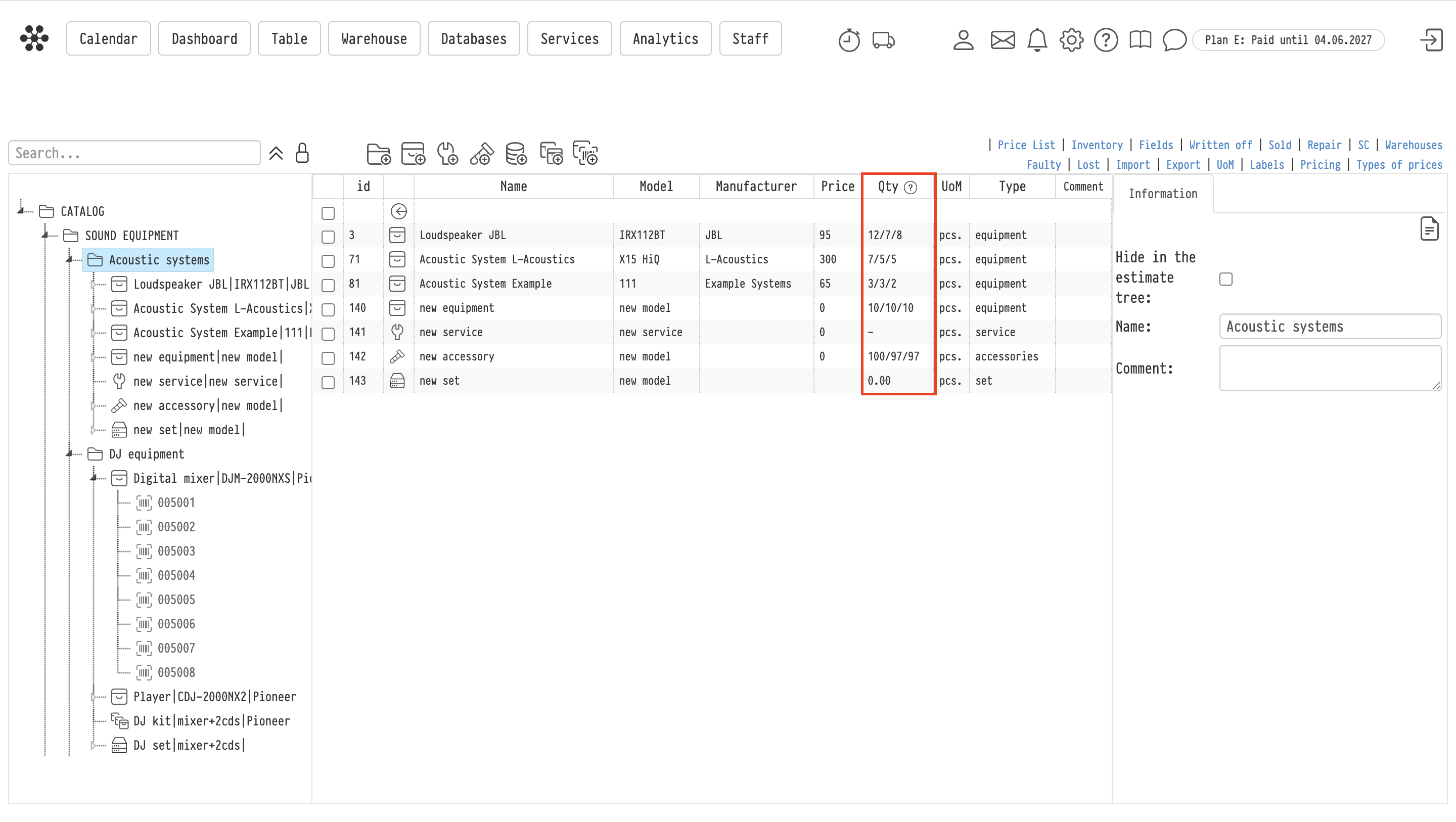
The catalog table has a Qty column with a help icon next to its heading. For equipment and accessories it shows three numbers separated by slashes — for example, 12/7/8.
Value | What it shows |
|---|---|
Qty | How many units the entry has in total — including faulty and lost ones, those under repair, and those that are part of a set |
Available | How many of them are free right now, after bookings are deducted |
In stock | How many are physically in the warehouse right now |
There used to be two values, total and available. The third was added at users' request: warehouse staff need to see what is actually on the shelf, not what the system calculates as available.
Why "available" and "in stock" differ
They answer different questions. Available is what you can put on an estimate. In stock is what you will find on the shelf.
Booked but not yet shipped. The project has started and the equipment is reserved for it, but it has not left the warehouse. It is excluded from available — you cannot dispose of it. It is counted in in stock — physically it is right there. That is exactly the case in 12/7/8: of the eight free units in the warehouse, one is already booked.
Gone and not back yet. The reverse: the equipment is out on a project and not in the warehouse, but no booking is currently in force for it. Available then exceeds in stock.
Please note: both numbers are calculated for the current moment, not for a project's whole period. If you book equipment for a project that starts tomorrow, today's available will not change — the booking is not in force yet.
Why the first number is larger than the second
The gap between the total and the available figure is made up of SKUs you cannot dispose of individually:
faulty, lost and under repair units — they still belong to the entry, but cannot be issued;
units that are part of a set — such an SKU exists and is counted, but cannot be booked on its own: it only goes out to a project together with its set.
Written-off and sold SKUs are not included in the total. They have left circulation for good and no longer count towards the entry.
Not every type has three values
Three numbers appear where SKUs are tracked one by one — for equipment and accessories.
Consumables — a single number, the current balance. Consumables are written off rather than returned from a project.
Sets — a single number. A set is handled in the warehouse as one indivisible object.
Kits — a dash. A kit has no SKU of its own; its availability follows from the availability of the entries inside it.
Services — a dash. A service has no warehouse quantity, only a quantity on the estimate.
Relation to shortage
When adding items to an estimate, the system calculates availability for the project's dates, taking existing bookings into account. If the requested quantity exceeds what is available on those dates, a shortage appears.
So the number in the catalog and the shortage in a project may disagree: the catalog shows availability right now, the project shows it for its own dates.